Home / News / Is Paint Protection Worth It for Your Car in Adelaide? An Honest Guide
Is Paint Protection Worth It for Your Car in Adelaide? An Honest Guide
Most people first hear about paint protection from a car dealer. You've just signed the papers on a new car, and they slide a quote across the desk—a few hundred dollars, sometimes more, for "paint protection." No real explanation of what it does. Just a line on an invoice.
That's a poor introduction to something that actually matters. So here's a straight answer, based on 28 years of experience working on car detailing, including paint protection, window tinting in Adelaide: professional paint protection is worth it — but only when it's done properly. If it’s done carelessly, then it will result in wastage of your money.
What Your Car's Paint Is Actually Up Against
Your car has a clear coat as a transparent layer over the colour that gives it gloss and takes the brunt of daily exposure. That clearcoat is softer than most people expect. Bird droppings can etch into it within hours on a hot Adelaide day. Washing with the wrong technique leaves swirl marks. UV radiation degrades it slowly but permanently. Road grime and industrial fallout bond to the surface over time and become harder to remove the longer they sit.
None of this is dramatic or sudden. It accumulates. And by the time most car owners notice something is off, the damage is already well established, like the colour looks a bit flat, the panels don't have that depth, and so forth.
Wax, Sealant, or Ceramic — What's the Difference?
Not all car paint protection is the same; check the differences below that most installers bother to explain.
Type
Durability
Hardness
Gloss
Reapplication
Wax
4–8 weeks
Low
Moderate
Every 6–8 weeks
Paint Sealant
6–12 months
Low–Medium
Moderate
Once or twice yearly
Ceramic Coating
3–10+ years
9H–10H (Mohs)
Exceptional
None required
Wax is fine as part of a wash routine — it adds some shine and minor water repellency. But it wears off in weeks and provides no real hardness. A ceramic coating bonds permanently to the clear coat. It doesn't wash away, doesn't need quarterly reapplication, and creates a surface that's harder than the paint beneath it. That hardness is what makes the difference when bird acid, grit, or swirling contact hits the car.
Why Adelaide Is Harder on Paintwork Than Most Cities
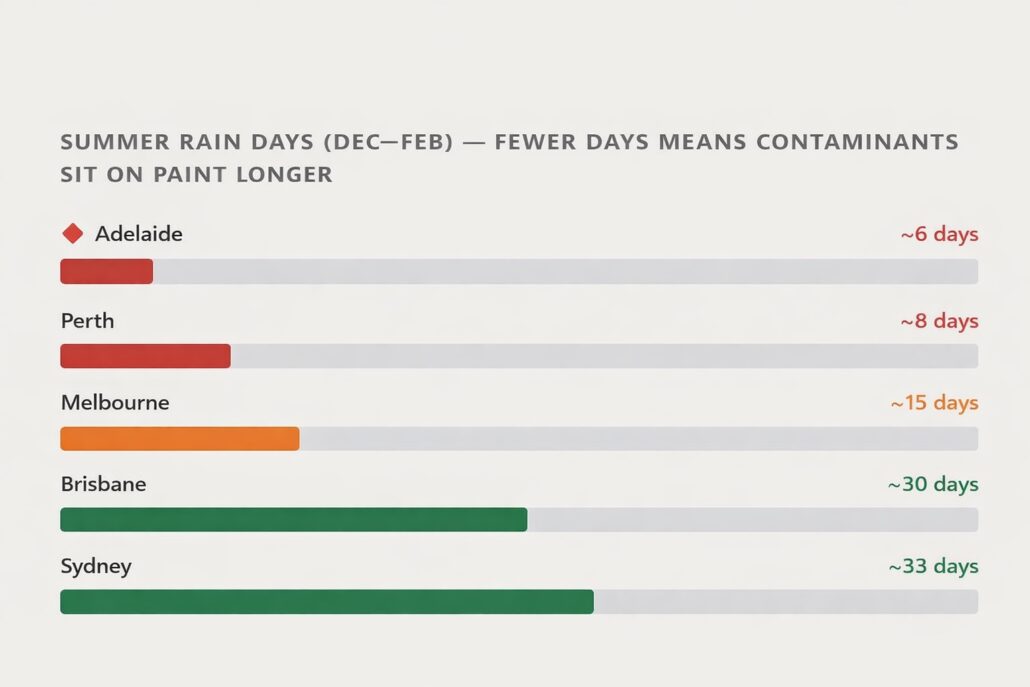
Like other people, you must have assumed that this is just because of UV, and yes, you are right. Adelaide's UV index during summer sits at 14–15, which is extreme. But Sydney and Melbourne hit similar peaks. The UV story alone doesn't tell you why Adelaide cars age faster. What tells the story is what happens between those sunny days: almost nothing. No rain, extreme heat, and very little humidity to slow down the chemical damage.
The table below compares the four climate factors that directly affect how quickly unprotected paint degrades across Adelaide and four other major Australian cities. All figures are long-term averages sourced from Bureau of Meteorology climate data.
City
Peak Summer UV Index ①
Annual Sunshine Hrs ②
Annual Rainfall (mm) ③
Summer Rain Days Dec–Feb ④
Days Above 35°C / Year ⑤
Paint Risk Rating
🔶 Adelaide
14–15
2,765
537
~6
~26
HIGH
Melbourne
14
2,200
516
~15
~10
MEDIUM
Perth
14
3,200
699
~8
~20
HIGH
Brisbane
15
3,000
916
~30
~3
MEDIUM
Sydney
14
2,600
1,150
~33
~5
LOWER
Sources: ① Copernicus Atmosphere Monitoring Service / nomadseason.com · ②③ Bureau of Meteorology climate averages (1991–2020) · ④ BOM monthly rainfall data, Dec–Feb averages · ⑤ BOM climate statistics—mean days max temp ≥35°C
A Sydney car gets natural rain to clear contaminants roughly 5× more often than an Adelaide car does over summer. Bird droppings, tree sap, and road dust that land on Adelaide's paint in December may still be sitting there in February, in the clear coat, in temperatures that regularly exceed 35°C.
That's the part most people miss. Brisbane has a higher peak UV index than Adelaide, but it gets 30 rainy days over summer, nature's rinse cycle. Adelaide gets around six. Contaminants that would wash off a Brisbane or Sydney car within days can sit on an Adelaide panel for weeks, slowly etching into the clear coat in heat that regularly tops 35°C. That combination of high UV, minimal summer rain, and extreme heat makes unprotected paint age faster in Adelaide than in most other areas.
What Happens When You Skip It
A car that is 3 to 4 years old and goes without protection usually needs paint correction before any coating can go on it. The paint correction will address swirl marks, bonded contamination, and early oxidation first. That preparation adds to the total cost in a way that early protection would have avoided entirely.
There's also resale value to consider. Protected, well-maintained paint looks noticeably different at sale time. Buyers respond to it. Dealers respond to it. The gloss and depth you hold onto with good protection can move the needle on what your car is actually worth when you sell it.
Preparation Is Where Most Jobs Fall Apart
A ceramic coating applied over paint that hasn't been properly prepared will lock in every swirl mark, scratch, and contamination particle permanently. You won't see it clearly on the day but in the right light, a few months later, you will.
A quality installer will assess the condition of your paint before anything goes on, carry out whatever correction is needed, and only then apply the coating. That step is not optional. Ask any installer you're considering: What does the preparation include? If the answer is vague, take that seriously.
Other things worth checking: MTA-approved status, product-specific certification, and real before-and-after results from actual customers' vehicles. Also ask about the SiO₂ content of the ceramic being used. We apply Wurtzite P85 — the only ceramic coating on the market with 85% SiO₂ solid content per kit. Many cheaper products sit at 50% or below, which affects both hardness and longevity.
When Should You Get It Done?
Ideally, right after you pick up a new car. Factory paint at delivery is as clean and defect-free as it's going to be. Coating it at that point means you're sealing perfect paint, and the result will be better for it.
If your car is a few years old, it's not too late — but get the paint assessed properly so you know what preparation is required before coating. The longer it goes without protection, the more work is involved to get it to the right starting point.
Is Paint Protection Worth It?
Yes — when it's done by someone who knows what they're doing, using a product that performs at a professional grade. The coating itself is only part of what you're paying for. The preparation, the eye for detail, and the experience behind the application are what determine whether the result holds up over years or disappoints within months.
If you're in Adelaide and want an honest assessment of your vehicle's paint condition before making a decision, give Ceramicar a call at 1300-605-531. No pressure, no upselling — just a straight conversation about what your car needs.
Most Adelaide car owners don't think about paint protection until they're standing in the driveway one afternoon and notice the panels don't look quite right anymore. The colour's still there, but the depth is gone. There's a dullness to it. A few scratches that weren't there last year. Maybe the bonnet's starting to show that […]
Most people first hear about paint protection from a car dealer. You've just signed the papers on a new car, and they slide a quote across the desk—a few hundred dollars, sometimes more, for "paint protection." No real explanation of what it does. Just a line on an invoice. That's a poor introduction to something […]
Drive-through car washes have their place — a quick rinse after a dusty week on the freeway, sure. But if you're trying to maintain the condition of your paint, your interior, or the resale value of the car, a wash doesn't get you there. Adelaide car detailing is a different service, done by hand, and […]
It is often very tough to keep your expensive car outside during chilly winters. With such prolonged exposure to fog, the exterior paint on your car would have its colour washed out, primarily at the early stages of corrosion. When you start parking your vehicle outside the house, its unprotected parts will get contaminated with […]